From Recycled Plastic to Perfect Prints: Nobufil PETG Matt Explained
Updated: Aug 3
If you already love PETG filament for its strength, durability, and reliability, you know it's a material that just works. But for those times when you want a different aesthetic - something that hides layer lines and gives your prints a premium, finished look - the search for a high-quality PETG Matt begins. And if you're also looking for sustainable options made in Europe, that search gets even narrower. That's exactly why we created this new line. With six new colors made right here in Austria from recycled industrial waste, we're finally filling that gap.
But before we dive into the six stunning new colors, let’s talk about what matte PETG actually is.
PETG Matt Filaments: How are they different from standard PETG?
So, what is the difference between PETG Matt and just PETG? Naturally, it’s all about the surface texture. Standard PETG filaments are known for their translucency and glossy shine. It reflects light, which can make layer lines pop out. Meanwhile, matte PETG filaments, on the other hand, use a modified formula that changes how the plastic cools and solidifies. The result is a surface that diffuses light rather than reflecting it, giving you a smooth, velvety finish that hides layer lines beautifully.
Speaking about its benefits, it keeps all the good stuff PETG is known for: strength, durability, and impact resistance. It handles heat and sunlight without fuss, doesn’t mind oils or solvents, and has just enough give to make snap-fit parts work without breaking.
However, the biggest benefit of PETG Matt is aesthetic. If you are printing cosplay props, architectural models, internal design objects, or consumer goods, the matte finish adds a premium look.
Less Stringing - a cool add-on
Standard PETG has a reputation for being stringy. It loves to leave little "hairs" when traveling between parts.
One of the advantages of matt PETG filament is that it is often slightly less prone to oozing than its glossy counterpart. However, it does require a bit of tuning. Because the additives that create the matte effect change the viscosity of the melted plastic, you typically want to.
Now, let's check if there are any disadvantages about it.
As for the disadvantages? It was usually considered that matte filaments were slightly weaker or had worse layer adhesion. However, with our new recycled PETG filament matt series, we have dialed in the formulation to minimize that gap. You might need to print slightly hotter than your usual standard PETG profile to ensure perfect fusion, but the durability remains impressive.
Printing with PETG Matt: What about print strength and layer adhesion?
Surely, the print quality can vary depending on the filament brand. Every manufacturer has their own formulation. We've all seen matte filaments that look beautiful but snap under pressure. Due to it, some users avoid matte filaments altogether. They feared brittleness or wondered if the matte finish came at the cost of layer adhesion.
However, if we speak about PETG Matt made by Nobufil, these filaments maintain their great impact resistance. It has the same durability you expect from glossy PETG. The layer adhesion is also strong.
Our testers reported that the parts printed with Nobufil PETG Matt hold up under real-world use. Furthermore, our technical analysis showed the same results for PETG Matt as for our glossy PETG. You can learn more about it in our technical datasheets.

Nonetheless, there are always some tricks to make your printing results better. In terms of the PETG and PETG Matt, we highly recommend you to make sure you dried filament well. And here is why:
Do You Need to Dry PETG Matt Before Printing?
PETG loves moisture. Matt PETG? Even more so.
Let’s understand the reasons: that velvety finish you love comes from additives that also make matte PETG more prone to absorbing water than glossy versions. The tiny particles that diffuse light and hide layer lines give moisture more surface to cling to. That means if you leave a matt filament spool out in humid air, it will soak up water faster than its glossy cousin.
As a consequence, too much moisture will show up when you print. You might hear tiny pops or sizzles as water turns to steam in the hotend. The wished smooth, even finish can get bubbly or patchy. In some cases, layers may not stick together as well. So, the print will be less resistant to the impact strength.
But don't worry. It's easy to prevent it.
Here are a few simple habits which will help you to keep your prints flawless:
Store smart. Keep spools in the vacuum-sealed bag with desiccant. If you print often, a filament dry box is worth it.
Dry when needed. Hear popping during a print? Dry the spool in a regular oven at 60°C for 3–4 hours, or use a dedicated filament dryer.
Print from a dry box. Long prints or humid days? Printing straight from a dry box keeps moisture at bay.
A dry spool makes a big difference, especially when you’re chasing that perfect, smooth surface.
TIP: For more on storage, drying, and fine-tuning your PETG settings, our complete PETG filament guide has everything from retraction tips to temperature tweaks.
Sustainability of Nobufil PETG Matt Filaments
When we talk about sustainable 3D printing, Nobufil walks the talk.
Let's be honest—sustainability claims in 3D printing can feel vague. Lots of brands say it, few show it. Nobufil is different. Based in Krems an der Donau, Austria, they handle everything in-house: recycling, compounding, extrusion—full control over the process and materials.
Our PETG filament starts as 100% recycled post-industrial plastic waste — clean leftovers from manufacturing that would otherwise end up in landfills. Because the raw materials come from Austria and nearby EU countries, there’s no need for long-haul shipping that burns tons of fuel. It’s regional, transparent, and genuinely circular.
You might wonder: does recycled mean weaker? Not here. Nobufil’s philosophy is that recycled filament should match the performance of virgin material. Every batch undergoes multiple quality checks—from incoming material to finished spools. The PETG Matt works smoothly on most printers, giving clean layers, strong impact resistance, minimal warping, and reliable layer adhesion—just like any high-quality PETG.
Even the details are thought through: recycled spools, eco-friendly boxes, and a clever way to reuse the packaging as a spool holder with just a printed adapter.
And yes, the filament looks as good as it performs.
Six New Colors – Made for Your Next Project
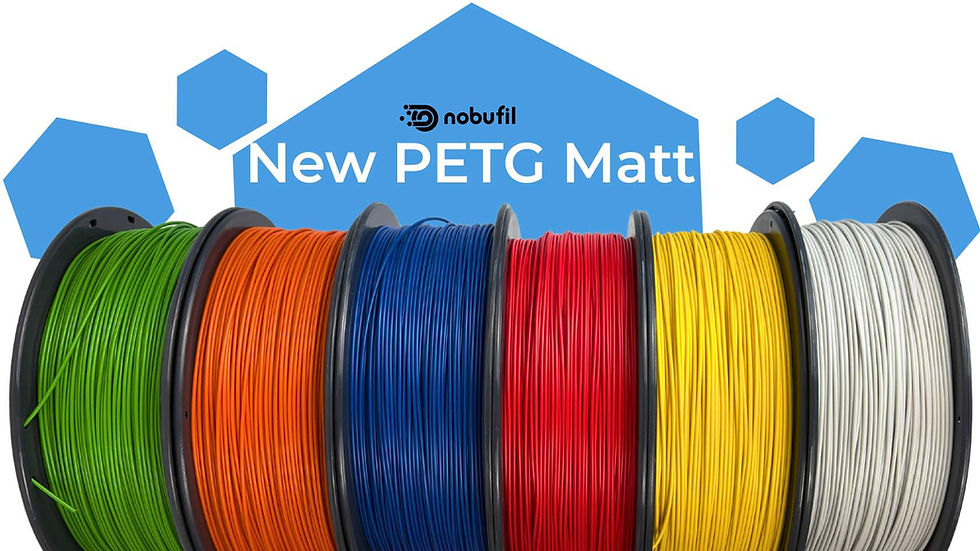
Now for the fun part. Our new PETG filament matt line comes in six carefully selected colors that bring out the best of the matte finish. Those colors will be quite familiar to you, because if you are our regular customer, you printed them already in their glossy version.
Whether you're after subtle neutrals for architectural models or bold tones for consumer goods, there's something here for every project.

Each spool delivers the same performance, sustainability, and premium surface quality we've covered above. Ready to give PETG matt a try?

![Everything about PCTG Filaments: the bigger brother of PETG [2026]](https://static.wixstatic.com/media/c9047f_ebbb3c0d547441f5a048d0677225cddf~mv2.jpg/v1/fill/w_980,h_551,al_c,q_85,usm_0.66_1.00_0.01,enc_avif,quality_auto/c9047f_ebbb3c0d547441f5a048d0677225cddf~mv2.jpg)

![PETG 3D Printing: Everything You Need to Know About PETG Filament [2023]](https://static.wixstatic.com/media/c9047f_ef298ec8ccd24a53882750f7f7aab48a~mv2.png/v1/fill/w_980,h_551,al_c,q_90,usm_0.66_1.00_0.01,enc_avif,quality_auto/c9047f_ef298ec8ccd24a53882750f7f7aab48a~mv2.png)
Comments